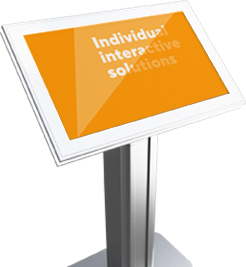
 The interactive table is a large touch screen that can be controlled with touch support. The desktop system has a touch display with a built-in system unit, a vandal-proof housing and a strong, stable base. Advanced models provide the ability to connect Internet cameras, Wi-Fi and Bluetooth adapters, and various scanners.
The history of the touch screen begins in 1970, when Samuel Hurst, a professor at the University of Kentucky, founded the company Elotouch to solve the problem of reading data from tape recorders. The company was a pioneer in the production of touch screens. The 1st device worked according to the resistive principle of determining coordinates. This ushered in the development of the field of touch screens and related devices. An interactive touch table consists of a case that can be designed in different ways, a large computer and a sufficiently large LCD or plasma display. There are tables that consist only of massive legs and a touch panel. The work plate of the table screen can have several positions of rotation and can be located horizontally and at an angle to the scroll. You can rent an interactive table with different diagonals, the most popular (28″, 32″, 42″, 46″, 55″). Depending on the tasks and scope of implementation, the table can be made in different versions: MDF, acrylic and fiberglass, artificial stone, metal and powder coating, tempered glass. The cover can be any color of the buyer’s choice. Marketing imprints can also be placed on the case. The computer interface can support operating systems such as Windows, Android, Mac, Linux. The interactive table itself can be equipped with Wi-Fi and Bluetooth systems, which is not surprising. It also has a built-in webcam feature — a custom option. The next fundamental characteristic of the interactive table is the development of the reception screen. Different informants highlight six (sometimes seven) touch screen manufacturing technologies. But in practice, only 4 basic principles are used in these devices — resistive, capacitive, acoustic and infrared. Renting interactive desktop equipment provides the main function of running games or applications. Thanks to the device, certain people can work. The touch screen instantly recognizes from 1-2 to 50-60 touches. This opens up new possibilities for group and group activities. This may seem like a question of how to use an interactive table for what your company needs. For example, for a demo. The large screen shows the details of the slides. Images can be simply rotated 360°, enlarged, subtracted. Thanks to this, every viewer can see the picture. The functions of the interactive table include various possibilities. For example, it is allowed to take photos and videos on the device’s memory. There is also an option to browse pages. Users have unlimited possibilities when working with an interactive table. They have all the possibilities to draw, make short animations or write stories.
Вопрос-ответ
Какие основные технологии используются в интерактивных столах и чем они отличаются?
В интерактивных столах применяются четыре базовые технологии сенсорного ввода: резистивная, емкостная, акустико-рефлекторная и инфракрасная. Резистивные и емкостные сенсоры наиболее распространены: резистивные работают по смене электрического сопротивления при касании, требуют точку касания, работают с любым стилусом; емкостные чувствительны к электропроводящим касаниям и обычно поддерживают мультитач. Акустико-рефлекторные и инфракрасные решения применяются в разной степени и зависят от конструкции поверхности и требований к долговечности и точности. В практике чаще встречаются резистивные, емкостные и инфракрасные панели.
Какие варианты сборки и материалы могут быть у интерактивного стола?
Стол может иметь разную компоновку: корпус может быть выполнен из MDF, акрила, стекла, металлических материалов или искусственного камня; поверхность может быть зашлифована под различные цвета и иметь тиснение. Наличие подставки, вращающейся рабочей поверхности и возможности установки LCD или плазменного экрана различной диагонали (28″, 32″, 42″, 46″, 55″) обеспечивает гибкость применения. Также встречаются варианты с встроенной веб-камерой, Wi‑Fi и Bluetooth, а компьютерный интерфейс поддерживает ОС Windows, Android, Mac, Linux.
Какую функциональность чаще всего предлагают интерактивные столы?
Основная функция — запуск игр и приложений на большом сенсорном дисплее, поддержка мультитач от 1–2 до 50–60 одновремённых касаний, что позволяет работать в группе. Дополнительные возможности включают просмотр и вращение изображений, масштабирование, создание заметок, фотографирование и видеосъёмку, веб‑серфинг и просмотр документов. В некоторых моделях присутствуют камеры, запись на внутреннюю память устройства и подключение к сетям через Wi‑Fi/Bluetooth.
Какие преимущества даёт использование интерактивного стола для бизнеса?
Интерактивный стол облегчает проведение презентаций и демонстраций: крупный экран улучшает восприятие деталей, позволяет совместную работу, упрощает взаимодействие с материалами через вращение, зумирование и аннотирование. Мало того, сенсорная совместная работа стимулирует вовлеченность аудитории, ускоряет процесс обсуждений и обучения. Гибкость конфигурации позволяет адаптировать стол под задачи конкретной компании: от обучения персонала до демонстраций продуктов и интерактивных демонстраций.